Pharmaceutical Production

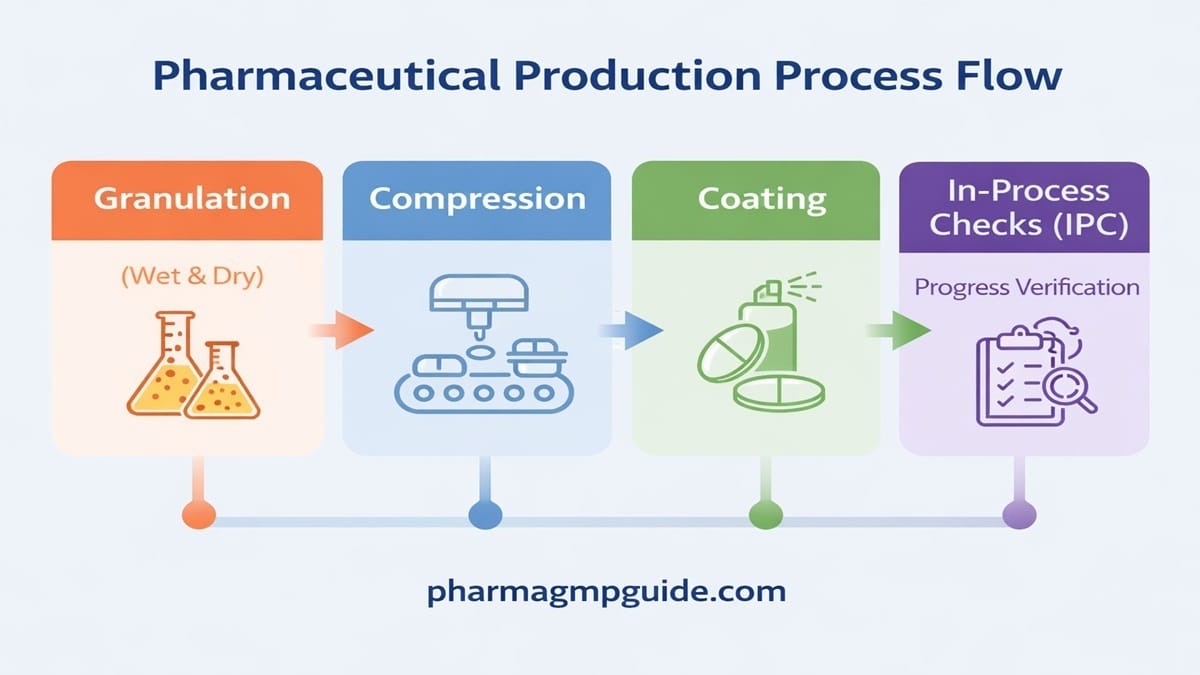
Pharmaceutical production process flow chart showing granulation compression coating and in-process checks IPC in drug manufacturing
Step-by-step pharmaceutical production process including granulation, compression, coating, and IPC checks as per GMP guidelines.

The Pharmaceutical Production category is one of the most critical sections in drug manufacturing, covering all major processes involved in converting raw materials into finished pharmaceutical products under strict GMP guidelines.

This section provides detailed, step-by-step guidance on key manufacturing stages such as granulation, tablet compression, coating, capsule filling, liquid manufacturing, and in-process quality control (IPC). Each topic is explained with practical industry examples to help professionals understand real-time production challenges and solutions.

Whether you are a student, production operator, or working in the pharmaceutical industry, this category will help you build strong technical knowledge, improve GMP compliance understanding, and prepare for interviews with real-life troubleshooting insights.

Key Topics Covered:

Pharmaceutical production directly impacts product quality, safety, and efficacy. Even a small error in the manufacturing process can lead to batch rejection or regulatory issues, making it essential to understand each step in detail.

Explore the articles below to understand each pharmaceutical manufacturing process in detail and improve your GMP knowledge step-by-step.

Fluid Bed Dryer (FBD) in pharmaceutical manufacturing showing working principle with hot air flow and granule fluidization
Pharmaceutical Production, Granulation

“Fluid Bed Dryer (FBD) in Pharma: Working Principle + 7 Common Problems & Solutions”

Introduction If you’ve ever worked in a granulation area, you already know one thing—drying is where most mistakes happen. Wet granules look perfect, but if drying goes wrong: That’s where the Fluid Bed Dryer (FBD) becomes a game-changer. Unlike tray drying (slow and uneven), FBD gives:✔ Fast drying✔ Uniform moisture removal✔ Better product quality In […]

Disintegration test (DT) apparatus showing tablet breakdown in pharmaceutical quality control under 37°C conditions
Pharmaceutical Production, In-Process Checks (IPC)

Disintegration Test (DT) in Pharmaceuticals: Complete Guide with Procedure, Equipment & Limits

Introduction In pharmaceutical manufacturing, ensuring that a tablet or capsule breaks down properly after administration is critical for drug release and absorption. This is where the Disintegration Test (DT) plays a vital role. Disintegration testing confirms whether a dosage form breaks into smaller particles within a specified time under controlled conditions. It is a mandatory

Compression force vs tablet quality infographic showing impact on hardness dissolution friability and tablet defects in pharmaceutical manufacturing
Pharmaceutical Production, Compression

Compression Force vs Tablet Quality: Working Principle Explained (Complete GMP Guide)

Introduction In tablet manufacturing, compression force is one of the most critical process parameters that directly controls tablet quality. A slight variation in force can lead to major defects like capping, lamination, hardness variation, or dissolution failure. From a GMP and production perspective, understanding the relationship between compression force and tablet properties is essential for

Tablet thickness measurement using digital caliper during pharmaceutical compression IPC check in GMP manufacturing
Pharmaceutical Production, In-Process Checks (IPC)

Tablet Thickness Variation in Compression: IPC Checks, Causes & Troubleshooting Guide

📌 Introduction Tablet thickness is one of the most critical In-Process Checks (IPC) during compression. Even though it looks like a simple parameter, variation in thickness directly indicates problems in compression force, powder flow, or machine settings. If not controlled: 👉 In real production, thickness variation is often the first signal of compression instability. To

Tablet Friability Test infographic showing friabilator, USP limit, 7 step procedure and troubleshooting in pharmaceutical manufacturing – Pharma GMP Guide
Pharmaceutical Production, In-Process Checks (IPC)

Tablet Friability Test: Complete Guide (Procedure, Limits, Calculation & Troubleshooting)

Introduction In tablet manufacturing, producing a tablet is not enough—it must survive handling, packaging, transport, and patient use without breaking. One of the most common real-life problems in pharma plants is: This is where the Tablet Friability Test becomes critical. 👉 It directly evaluates how strong your tablets are against mechanical stress and abrasion. If

Friability test calculation formula and IPC limits showing percent weight loss in tablet manufacturing
Pharmaceutical Production, In-Process Checks (IPC)

Friability Failure in Tablets: Causes, Limits & Troubleshooting (Complete GMP Guide)

What is Friability Failure in Tablets and Why It Happen in Pharmaceutical Manufacturing Friability failure is one of the most common problems in tablet manufacturing.It directly indicates tablet strength and durability. 👉 In simple words:If tablets break, chip, or generate powder during handling → friability is failing In real pharma production, friability failure often leads

Tablet hardness variation causes, IPC limits and troubleshooting in pharmaceutical manufacturing
Pharmaceutical Production, Compression

Tablet Hardness Variation: Causes, IPC Limits & Troubleshooting (Complete GMP Guide)

Introduction Tablet hardness is one of the most critical in-process quality parameters in pharmaceutical manufacturing. If hardness is not controlled properly, it directly affects: In real production, hardness variation is a very common issue, especially during compression. Even a slight change in machine settings or granule properties can lead to batch rejection. In this guide,

In-Process Checks During Granulation in Pharmaceutical Manufacturing infographic showing IPC steps, moisture content check, granule size distribution and GMP process – Pharma GMP Guide
Pharmaceutical Production, Granulation

In-Process Checks During Granulation in Pharmaceutical Manufacturing

Quick Answer In-process checks during granulation are quality control checks performed during the granulation process to ensure that the granules meet predefined specifications such as moisture content, particle size, density, and flow properties before moving to the next manufacturing stage. These checks help maintain product quality, batch consistency, and GMP compliance. Pharmaceutical manufacturing processes must

pharmaceutical packaging line showing blister pack bottle and carton packing in GMP manufacturing facility
Pharmaceutical Production, pharmaceutical-packaging-operations

Pharmaceutical Packaging Process in GMP: Complete Guide to Packing Operations

Introduction The pharmaceutical packaging process is a critical stage in drug manufacturing where finished medicines are packed into protective containers before distribution. Packaging ensures that pharmaceutical products remain safe, stable, and protected from contamination, moisture, and physical damage. In pharmaceutical industries, packaging operations must follow strict Good Manufacturing Practices (GMP) to prevent mix-ups, labeling errors,

Scroll to Top